Share article
Babywearing is a natural practice that offers many benefits, both for the child and the parent. Many families choose to carry their baby to promote closeness, strengthen their child’s sense of security, and make everyday activities easier.
When done correctly, physiological babywearing respects the infant’s anatomy and supports their motor, postural, and emotional development. By keeping the baby in a position appropriate for their development, it can also promote calmness, sleep, and digestive comfort.
To fully benefit from these advantages, it is essential to use a carrier suited to your baby’s age and body shape, while ensuring that safe and physiological babywearing principles are followed.
Understanding the Baby’s Physiology
To understand what a physiological posture is, it is helpful to look at the natural development of a baby’s posture. When it comes to babywearing, two elements are particularly important: the position of the spine and the position of the hips.
Respecting these two aspects helps adequately support the infant’s body while promoting a posture appropriate for their stage of development.
The Infant’s Spine
At birth, a baby’s back has one large rounded curve, called thoracic kyphosis. This is the position naturally adopted in the womb. Since their muscles are still immature, newborns cannot hold their trunk against gravity or straighten themselves independently. Babywearing that respects this natural curve adequately supports the baby’s spine and helps distribute pressure evenly, while providing a comfortable position appropriate for their stage of development.
Over the months, the curves of the spine gradually develop:
- Cervical lordosis (in the neck) appears when the baby learns to hold their head up (around 3 months).
- The reduction of thoracic kyphosis (a less “rounded” back) develops through tummy time, rolling (back to tummy), and crawling on all fours (6 to 8 months).
- Lumbar lordosis (the inward curve in the lower back) develops with upright positioning (standing) and walking (9 to 12 months).
Promoting Proper Hip Development in Babies
The hip joint is made up of two parts: the acetabulum, a socket located in the pelvis, and the head of the femur, which fits into it. At birth, this joint is still developing. The femoral head is nicely rounded, while the acetabulum is relatively shallow and partly made of cartilage, making the hip more flexible and less stable than in an adult.
During pregnancy, the baby naturally adopts a position in which the hips are flexed and the legs are tucked toward the body. This posture promotes normal development of the joint.
After birth, it is recommended to maintain this position during babywearing. The so-called “frog-leg” position (hips flexed and slightly spread apart, with the knees higher than the buttocks) provides good support for the hips while respecting their natural development.
Conversely, a position in which the legs are straight and hanging downward provides less adequate hip support. In some infants with risk factors, this position could contribute to the development or worsening of hip dysplasia, a condition in which the joint develops abnormally. Since this condition is generally painless in babies, it can go unnoticed without screening. The risk is greater during the first few months of life, when the hips are most malleable.
Physiological babywearing, which keeps the hips flexed and slightly open, promotes proper positioning of the femoral head within the acetabulum. This position contributes to an appropriate distribution of pressure within the joint and supports harmonious development.
The Physiological Position During Babywearing
The physiological position is therefore one that respects the infant’s natural posture while ensuring safety, clear breathing, and comfort.
Key points for maintaining this position during babywearing:
- C-shaped rounded back: to support proper spinal development.
- Tilted pelvis: baby is sitting on their bottom rather than being suspended by the crotch, promoting comfort, proper hip positioning, and blood circulation in the legs.
- Knees higher than the buttocks (frog-leg position): legs naturally flexed and slightly spread apart to promote proper hip development.
- Hands close to the face, which reassures the baby.
- Face visible: airways remain clear (you should be able to slide two fingers between the chin and chest).
- Baby at kissing height: allowing for frequent visual contact.
Other Babywearing Options
In addition to the more traditional tummy-to-tummy position, you can also carry your baby on your side (on your hip) or on your back. The side position is generally preferred by more curious babies who want to observe their surroundings. It requires a baby carrier/wrap that is designed for this position. Back carrying is suitable for older babies (from around 5–6 months), as the baby needs greater control of their head position.
How Should Babywearing Be Adapted According to Baby’s Age?
Your baby grows, and babywearing adapts to their new muscle tone and abilities. As your baby grows, the carrying position becomes less curled and less close to the wearer’s body, allowing the child more freedom of movement.
0 to 3 Months: Very Supportive Babywearing
During the first few months, babies still have very little muscle tone. Their back naturally remains rounded in a C shape, and they do not yet have head control. Babywearing should therefore be particularly supportive, providing maximum support for the back, head, and pelvis.
At this age, the goal is a well-supported, tucked-in position: the pelvis is tilted, the legs are only slightly spread apart, and the baby is carried high on the parent, at kissing height.
4 to 6 Months: More Muscle Tone, but Still Plenty of Support
Between 3 and 6 months, babies begin to have better head control and stronger support from their limbs. The cervical curve gradually develops, but the back remains rounded and should continue to be well supported.
Babywearing can then allow a little more freedom in the upper body, particularly around the arms, while maintaining a physiological position. The natural opening of the hips can also become slightly greater.
7 to 9 Months: More Mobile Babywearing
When babies begin crawling on all fours, generally between 6 and 9 months, their upper body becomes more upright and their stability increases. They also become more active and curious about their surroundings.
Babywearing can then be slightly less snug, allowing more freedom around the arms and trunk. At this stage, back carrying is often appreciated by both the child and the parent, as it facilitates movement and improves the wearer’s comfort.
10 to 12 Months and Beyond: Occasional Babywearing
When the child begins standing, walking, or wanting to explore more, lumbar lordosis gradually develops. Babywearing then tends to become more occasional, used for comfort, getting around, or during periods of fatigue.
At this stage, the curled position is less pronounced and the child benefits from greater freedom of movement. Back carrying is often preferred to better distribute the weight and maintain the parent’s comfort.
The Benefits of Babywearing
In Terms of Motor Development
- Strengthens the muscles of the neck, back, and trunk.
- Develops balance through the wearer’s movements.
- Stimulates the senses and curiosity through observation of the environment.
- Promotes freer and more confident movements.
In Terms of Health
- Promotes digestion and reduces reflux and colic by keeping the child upright.
- Helps with breathing in cases of bronchiolitis or congestion, thanks to an upright position that improves ventilation.
- Reduces the risk of plagiocephaly (flat head), as babywearing allows for greater positional variety throughout the day and limits the amount of time the baby’s head rests against a hard surface.
For more information on this topic, we recommend this article: Flat Head Syndrome (Plagiocephaly) in Babies: How to Prevent and Treat It
In Terms of Sleep and Emotions
Being carried soothes the baby:
- The parent’s proximity helps regulate their nervous system.
- Warmth and rhythmic movements recall the womb environment.
- The calming effect reduces crying and agitation.
- Physical contact stimulates oxytocin, the bonding hormone.
Common Mistakes to Avoid
Certain habits or equipment may affect the baby’s comfort or fail to respect their physiological posture. Here are the main mistakes to avoid:
- Placing baby facing outward too early. This position places greater demands on the spine and hips while exposing the baby to significant sensory stimulation that they may not always be able to manage.
- Using a baby carrier that supports the baby only by the crotch. A physiological baby carrier should support the thighs from one knee to the other to maintain the hips in a flexed and slightly open position.
- Allowing the baby’s legs to hang downward or adopting a position that is too extended. This posture does not respect the natural position of the hips and provides less adequate support for the joint.
- Extending the amount of time spent in certain devices, such as an infant car seat (when used outside the vehicle), rocking seat, or activity center. Although convenient on occasion, these should not replace periods of babywearing, being held, or freely spending time on the floor. As for the Jolly Jumper, its use is not recommended.
Which Baby Carrier Should You Choose?
The choice of equipment depends on your baby’s age, muscle tone, your level of comfort, and how you plan to use it on a daily basis. Each option has advantages, but also certain limitations to consider when choosing a carrying method suited to your needs.
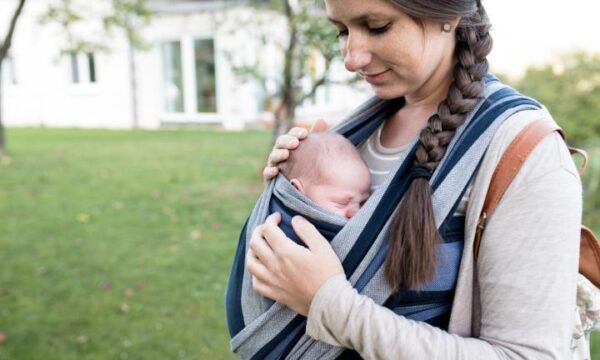
Woven Wrap
A woven wrap provides optimal support and adapts very well to both the baby’s and parent’s body shape. It is adjustable and can generally be used from birth until around 3 years of age.
Its main disadvantage is that it requires some learning. The fabric is more technical, and you need to take the time to master the different wrapping techniques to use it safely and comfortably.
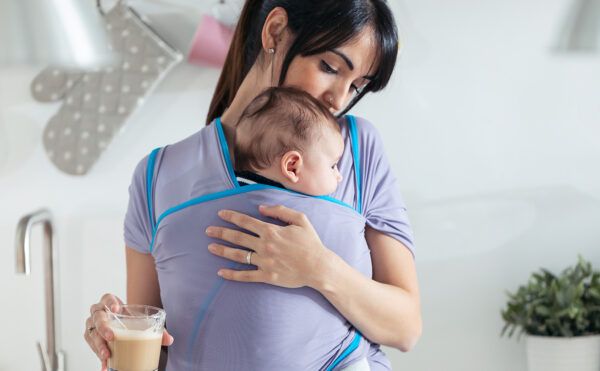
Stretch Jersey Wrap
A stretchy wrap is often appreciated for its ease of use. It generally requires learning only one wrapping technique, which can reassure parents who are new to babywearing.
However, it provides less support than a woven wrap. It is mainly suited to very young babies and is generally used up to around 7 kg.
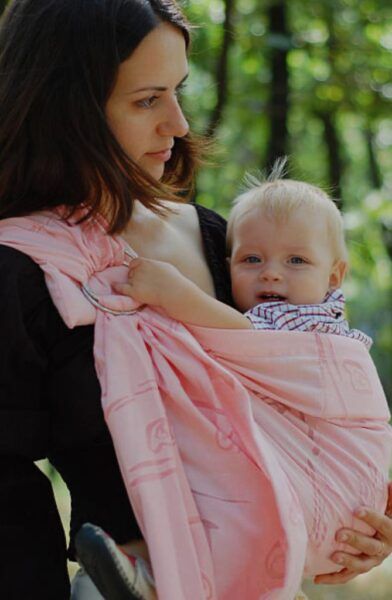
Ring Sling
A sling is a quick and practical option, particularly useful for short trips or situations when you want to get your baby settled quickly.
Since it is an asymmetrical carrying method, more weight rests on one shoulder. It can therefore become less comfortable when used for extended periods.
Mei-tai
A mei tai is a semi-structured baby carrier that combines some of the advantages of a wrap and a structured carrier. It is generally easy to put on and comfortable for the wearer.
However, depending on the model, it may not be well suited to newborns. It is therefore important to check the manufacturer’s recommendations and ensure that it properly supports the baby’s physiological posture.
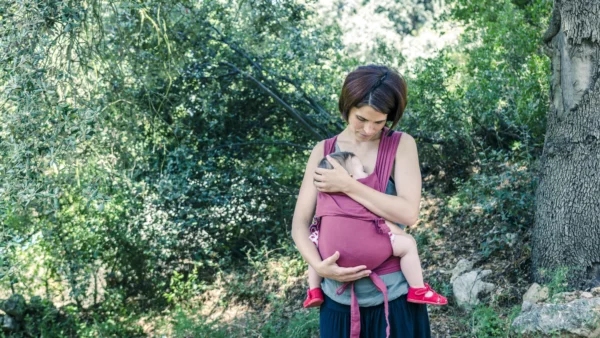
Physiological or Structured Baby Carrier
A physiological baby carrier is appreciated for its ease of use and comfort. It can be an interesting option for parents who want a more structured system that is quick to adjust.
However, it can often only be used from 3 to 4 months of age, depending on the model and the baby’s development. It may also be bulkier and more expensive than other babywearing options.
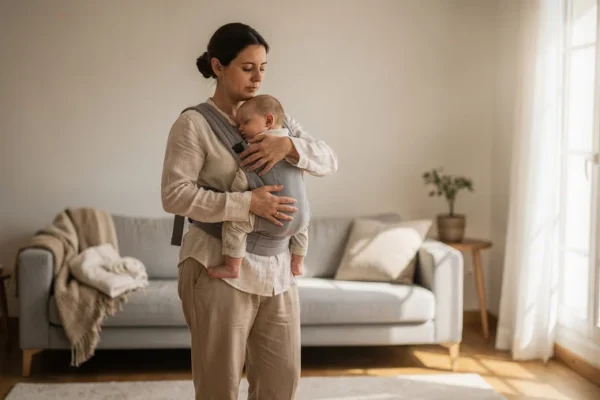
Contraindications to Babywearing (or Situations Requiring Professional Advice)
Babywearing may be temporarily or partially contraindicated in certain situations:
- Premature baby or baby with significant health issues (respiratory, cardiac, neuromuscular, malformations, etc.): seek advice from a healthcare professional before babywearing.
- Very low muscle tone or inability to maintain a stable position without slumping: babywearing may require specific adjustments or may need to be postponed.
- Significant and persistent discomfort in the baby: babywearing should be adapted or avoided depending on the situation.
- Minimum weight of 3.2 kg to allow babywearing.
Essential Elements to Check for Safe Babywearing
Airways and Position
- Baby’s face must always be visible, with the mouth and nose unobstructed at all times.
- The chin must be clear of the chest (avoid excessive neck flexion) to keep the airways open.
- The head must be supported, especially in newborns, without being trapped or pressed against the parent.
Posture and Adjustment
- The back should be well supported, without slumping, in a natural curve.
- Baby should be carried high and close to the parent’s body, with the carrier properly adjusted.
- Follow the manufacturer’s instructions (age, weight, permitted positions).
Comfort and Environnement
- Monitor temperature: avoid overheating by adjusting clothing and layers.
- Regularly check the baby’s overall well-being (colour, breathing, muscle tone).
General Saftey
- Never carry a baby in a moving vehicle (car, public transportation, bicycle).
- Adapt babywearing to the activity (avoid sudden movements and fall risks).
Frequently Asked Questions fréquentes
When can I start carrying my baby facing outward?
At a minimum, from 5–6 months, and only when:
- Baby has very strong head control;
- Baby actively rolls over;
- Baby shows a strong need to explore.
Can I carry my baby if they have gastroesophageal reflux (GERD)?
Yes, babywearing is often beneficial because of the baby’s upright position.
How long can I carry my baby?
There is no time limit as long as babywearing is comfortable, the baby is properly positioned, and breathing freely.
How can I prevent lower back pain as a parent?
- Position the baby high enough (at kissing height).
- Tighten the straps/panels properly so that the child does not “fall” downward or forward; keep the baby’s weight as close to your body as possible.
- Distribute the weight across both shoulders (or alternate shoulders when using a sling).
- Engage your lower abdominal muscles and maintain an upright posture.
In Summary
Physiological babywearing is much more than simply a means of transportation: it meets a baby’s needs for closeness, security, and development while making everyday life easier for parents. When it respects the child’s natural posture, it promotes motor development, soothes emotions, improves digestive comfort, and supports bonding.
Here are a few key points to remember:
- Make sure the baby’s face is always visible and unobstructed.
- Ensure that the back is rounded and the pelvis is properly tilted.
- Support the legs down to the knees.
- Position the baby at kissing height.
- Respect the natural opening of the hips without ever forcing it.
- If the baby appears uncomfortable, adjust the position or take a break.
Do not hesitate to consult a certified babywearing educator for personalized guidance. An interactive resource library is available through the website of the Institut national du portage des enfants (INPE).
Book an appointment : www.kinatex.com/en/our-services/pediatric/
Share article