
Share article
Have you developed shoulder pain that has been persisting for a long time?
It could be a rotator cuff tendinopathy.
At Kinatex, our physiotherapists assess and treat rotator cuff tendinopathy to help you return to your activities without pain.
What is rotator cuff tendinopathy?
A tendon is a fibrous structure that connects a muscle to a bone, similar to a rope. It allows the transmission of force required for movement.
In the shoulder, four important muscles responsible for its stabilization form the rotator cuff. Their tendons attach to the humerus (the arm bone).
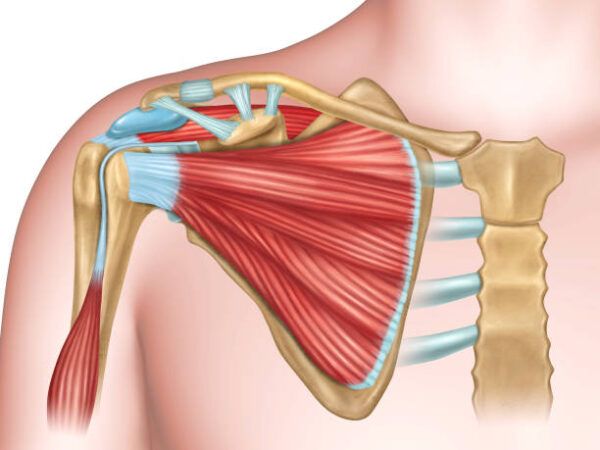
With every arm movement, the tendons are placed under tension, particularly during elevation and rotation movements. As a result, you may experience difficulty with certain daily tasks, such as reaching for a carton of milk at arm’s length in the refrigerator, putting on clothes, or washing your hair.
Some sports place high demands on the shoulder and are more likely to cause this type of injury. We frequently see baseball athletes, swimmers, volleyball players, and CrossFit practitioners. However, daily activities or work-related tasks can also be the source of this injury.
Rotator cuff tendinopathy occurs when the tendon is overloaded beyond its tolerance to stress. Over time, structural changes may appear, reducing its ability to recover if the condition is not properly treated.
The first stage corresponds to the acute phase of shoulder tendinitis. To learn more about this phase and the recommended actions, we invite you to consult this article.
When symptoms persist
Over time, the condition may not improve and can persist. The medical term used is chronic pain, meaning pain that lasts for more than three months.
The priority will be to ensure the following points:
- Rule out an external cause of the shoulder pain (e.g., referred pain from the cervical or thoracic spine, or a medical condition requiring medical care)
- Optimization of physical activity: for managing tendinopathies, it is important to neither do too much nor too little. We use the concept of mechanical stress quantification, which is explained in detail in this article. Although it discusses its use for the foot, this principle also applies to the shoulder.
- Optimization of biomechanics and posture: often overlooked but crucial in managing shoulder pain. The shoulder is a highly mobile joint that requires strong and precise muscle activation under optimal conditions.
- Correction of sporting or functional movement patterns, depending on your needs
- A muscle strengthening program, which may or may not include postural exercises and stretching

Complementary physiotherapy approaches
In addition, your Kinatex physiotherapist may use different approaches depending on what contributes most to your pain:
- Orthopedic manual therapy (cervical, thoracic, and/or shoulder)
- Muscle release techniques:
- Shockwave therapy: this approach is generally used when tendinopathies do not respond to traditional physiotherapy treatments. It is particularly recommended in the presence of tendon calcifications visible on X-ray.
To learn more about this last approach, we invite you to consult the following article: Shockwave therapy in physiotherapy
When to consult
When the condition becomes chronic (more than 3 months), the sooner you consult your Kinatex clinic, the more effectively and safely we can help you return to your activities.
Practical tips while waiting to see your physiotherapist:
- Gradually plan any increase in activity
- Respect a progressive training load
- Keep loads close to your body
- Prefer efforts at waist height
- Avoid keeping your arms above shoulder level for long periods
Clothing
- Prefer loose clothing or clothing that is easy to put on
- It is possible to fasten a bra at the front and then rotate it
- When putting on long sleeves, coats, or jackets, start with the painful arm
Sleep
- Maintain good sleep hygiene with a goal of more than 7 hours per night
- Sleeping on your back is generally more comfortable
- It is also possible to sleep on the non-painful side, with a pillow placed under the injured arm to unload the shoulder
Share article