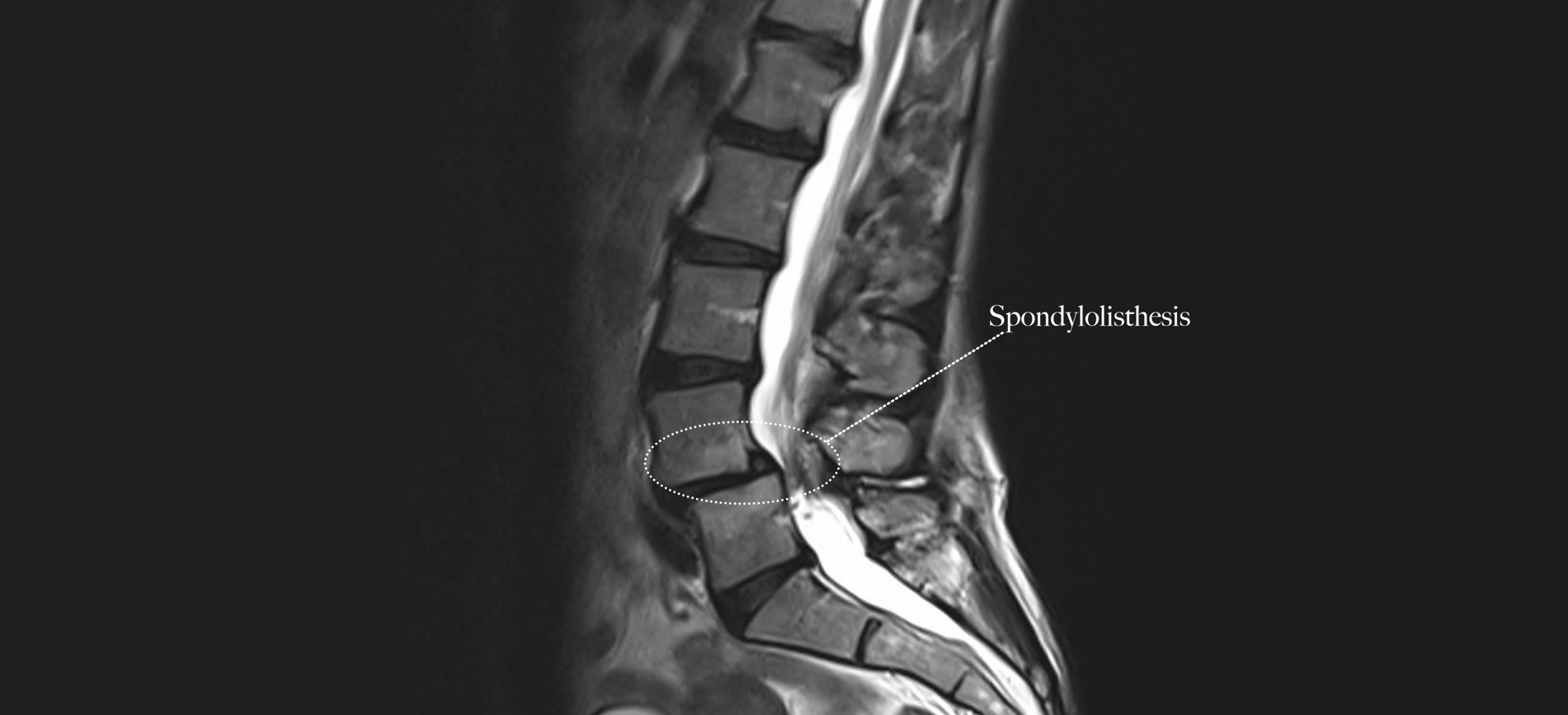
Spondylolysis refers to a stress fracture of the pars interarticularis, a small bony area located at the back of a lumbar vertebra, most commonly at the L5 level. This fracture is generally not caused by a single impact, but rather by an accumulation of repeated mechanical stress.
When the fracture is present on both sides of the vertebra, the vertebra may lose some of its stability and begin to slip forward relative to the vertebra below. This is known as isthmic spondylolisthesis. This condition is well documented in gymnasts and young athletes, and the physical demands of circus arts expose performers to similar stresses.
Scientific evidence shows that spondylolysis is primarily caused by repeated microtrauma rather than an acute injury. Movements involving repeated lumbar extension, especially when combined with rotation or loading (body weight, partner lifts, landings), increase shear forces on the vertebral pars interarticularis.
For circus artists, these stresses commonly occur during backbends, balancing work, dynamic acrobatics, aerial disciplines, and partner lifts. Over time, if training load exceeds the bone’s recovery capacity, a stress fracture can develop. If the fracture progresses or becomes bilateral, it can lead to vertebral slippage.
In practice, this is therefore an injury related to repetition, intensity, and movement control, rather than a single poorly executed movement.
Typical symptoms include:
Neurological deficits are rare, but may occur in more advanced cases of vertebral slippage.
Circus artists share several risk factors with gymnasts:
These factors help explain the potentially high prevalence of this condition within this population.
Physiotherapy plays a central role in conservative management:
An individualized approach often allows for a safe return to performance while reducing the risk of recurrence or progression of vertebral slippage.
References
Mohile, N. V., Kuczmarski, A. S., Lee, D., Warburton, C., Rakoczy, K., & Butler, A. J. (2022). Spondylolysis and Isthmic Spondylolisthesis: A Guide to Diagnosis and Management. Journal of the American Board of Family Medicine: JABFM, 35(6), 1204–1216.
Mohriak, R., Vargas Silva, P. D., Trandafilov, M., Jr, Martins, D. E., Wajchenberg, M., Cohen, M., & Puertas, E. B. (2015). Spondylolysis and Spondylolisthesis in Young Gymnasts. Revista Brasileira de Ortopedia, 45(1), 79–83.
Tallarico, R. A., Madom, I. A., & Palumbo, M. A. (2008). Spondylolysis and Spondylolisthesis in the Athlete. Sports Medicine and Arthroscopy Review, 16(1), 32–38.