Share article
What is bowel evacuation?
Whether it is to help you in the rehabilitation of pelvic or lumbar problems, here are some recommendations for bowel evacuation that will not have a deleterious effect on the lumbar and pelvic tissues.
Intestinal Massage
Ideally done 15 minutes after a meal for a period of 5 to 10min, following a brisk walk (5-10min), to encourage the gastro-colic reflex.
Could be repeated during bowel evacuation.
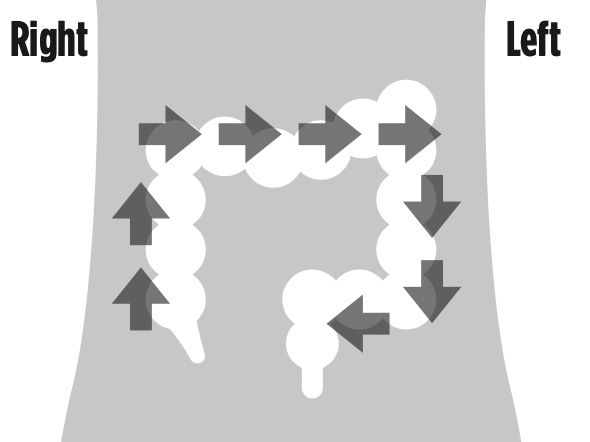
Apply firm pressure in a clockwise fashion as if the clock was on your stomach. Make a square with your hand using the following sequence.
- From the right iliac bone to the rib cage on the right side.
- Then from the right side of the rib cage to the left side.
- Then from the left rib cage towards the left iliac bone then angled downwards toward the belly button.
Evacuation Position
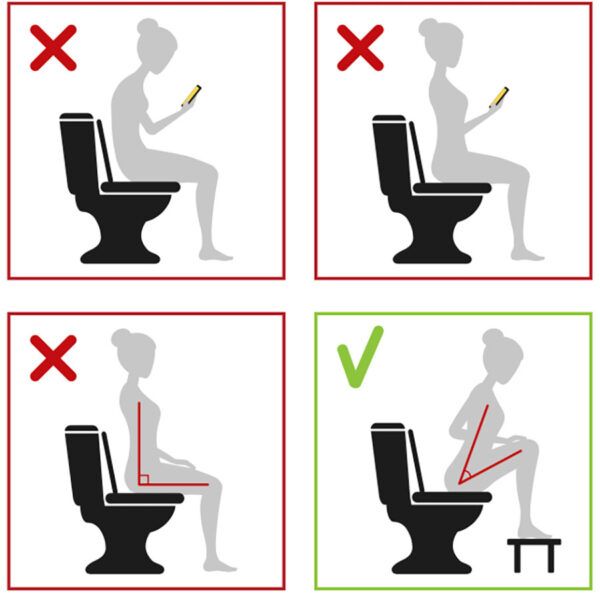
A slight increase in intra-abdominal pressure will help evacuate bowels.
- Sit on the toilet with your feet elevated so that your knees are higher than your hips. A « squatty potty « could be used.
- Bring your knees together and spread your feet apart.
- Support yourself with the forearms on your thighs.
- Relax the anal sphincter and pelvic floor.
- Take 5-10 deep breaths.
Breathing Technique
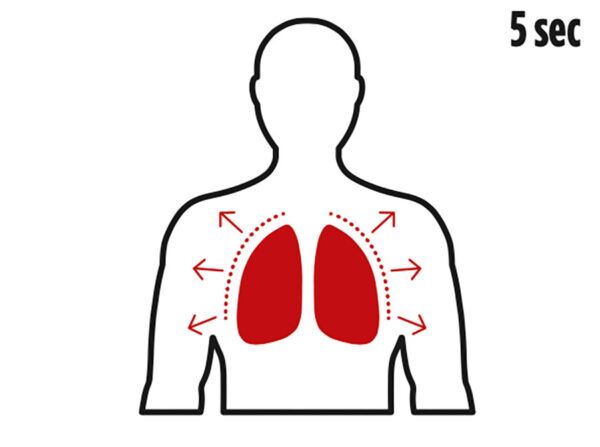
When you are ready to evacuate your stool, breathe deeply and blow into a semi-closed fist, while relaxing the pelvic floor and anal sphincter.
- Breathe in while expanding the abdomen.
- Hold the breath for 5 seconds.
- Blow into the semi-closed fist while contracting the abdominal muscles to pull the abdomen inward.
- With the other hand, apply a firm pressure on your lower abdomen.
- Repeat 5 to 10 times.
Diet
Liquids and insoluble fiber sources help move food bulk through intestines. Try to integrate to your diet:
- 8 glasses of liquid / day (2L).
- Dark green leafy vegetables.
- Dates and prunes.
- Whole wheat products.
- Seeds and nuts.
- Wheat bran (all BRAND BUDS cereals with psyllium).
- Fruit and vegetable skins and roots (carrot, cucumber, zucchini, celery, apples).
Share article