
Share article
Is your child involved in high-level sports? Are they part of a sport-study program?
To help you in your role as the parent of a young athlete, we explain the risk factors for overuse injuries, how to recognize their onset, and share our best tips.
To help you in your role as the parent of a young athlete, we explain the risk factors for overuse injuries, how to recognize their onset, and share our best tips.
In recent years, we have observed a significant increase in the number of children presenting with overuse injuries. This phenomenon is thought to be due to young athletes specializing in a single high-level sport at an increasingly early age and practicing it year-round, along with ever-increasing performance demands. In addition, we are also noticing a decrease in the time spent being active outside of training hours.
These injuries require long periods of rest and rehabilitation. It is therefore important to prioritize prevention over treatment.

What is an overtraining injury?
It is an injury caused by a training load or intensity that is too high for the athlete’s body’s capacity to adapt. They generally occur when there is an imbalance between training and rest periods. Pain is initially mild and gradually increases in intensity as the body part is forced to compensate for the activity. Overtraining can occur with as little as 8 to 10 hours of training per week.
The main overtraining factors are:
- A load that is too high in intensity or duration
- Insufficient recovery time
Some symptoms of overtraining:
- Significant fatigue
- Mood disturbances
- Muscle or joint pain that increases after training
- Decreased sports performance
- Decline in academic performance
- Weakened immune system

What about the impact of specializing in a single sport?
During the school years, it is recommended that children practice more than one sport to develop their cardiovascular system, musculature, coordination, body awareness, and cognitive abilities. It has been proven that children who try a variety of sports achieve better athletic performance. Take the example of Tom Brady, who played football, baseball, and basketball in high school. He is now one of the most well-known quarterbacks in the NFL.
Specialization — dedicating oneself to a single sport at a young age — does not improve athletic performance and increases the risk of overuse injuries. A study from Loyola University Chicago involving 1,200 young athletes revealed that children who specialized in a single sport were 70% to 93% more likely to get injured than those who played multiple sports.
What factors influence the onset of an overuse injury?
- Growth spurts
- Early specialization and degree of specialization in a sport
- High training and competition volume
- Previous injuries
- Psychological factors (anxiety, performance stress, burnout, etc.)
- Pressure from peers, coaches, or parents
- Anatomical factors (lack of coordination, muscle strength, posture, etc.)
- Suboptimal technique
- Poorly fitted equipment
As parents, you cannot influence every risk factor listed above. The important thing is to be able to talk with your child in order to detect risks and early symptoms.
The importance of quantifying mechanical stress
Most overuse injuries are caused by a load that is too high for what body tissues can tolerate. Whether in bones, cartilage, muscles, or tendons, stress that exceeds the tissues’ maximum adaptive capacity can lead to signs of injury.
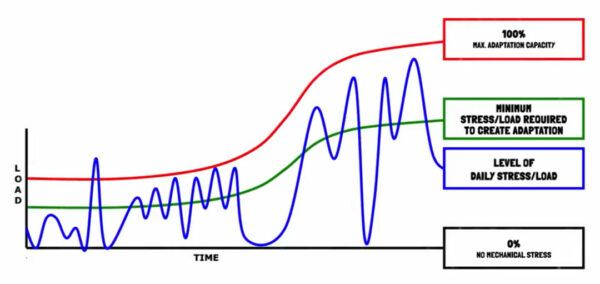
This training management is even more important in young people with an immature skeleton. Because a growing child’s skeleton develops faster than the muscles and tendons attached to it, a musculoskeletal imbalance occurs that is less able to tolerate the mechanical stress applied to it.
Tips to prevent overuse injuries
If your child practices one or more physical activities for several hours per week, here are some tips:
- Practice a variety of sports either weekly or at least seasonally
- Monitor pain during and after sports activities and consult if needed. Your child should not have recurring pain in a specific area
- Plan at least one rest day per week
- Increase the training load by a maximum of 10% per week in intensity OR duration
- Monitor training intensity more closely during growth spurts and reduce it if injuries occur
- Take a 2–3 month break each year to practice a different sport. All professional athletes have an off-season — your children should too
- Listen to your child: if they are tired or unmotivated, simply cancel the training session. Do not hesitate to take a longer break of a few weeks. You and your child will both benefit
When should you consult a physiotherapist?
If you recognize any of the symptoms discussed above, or simply for a preventive consultation, do not hesitate to make an appointment with one of our professionals.
Share article